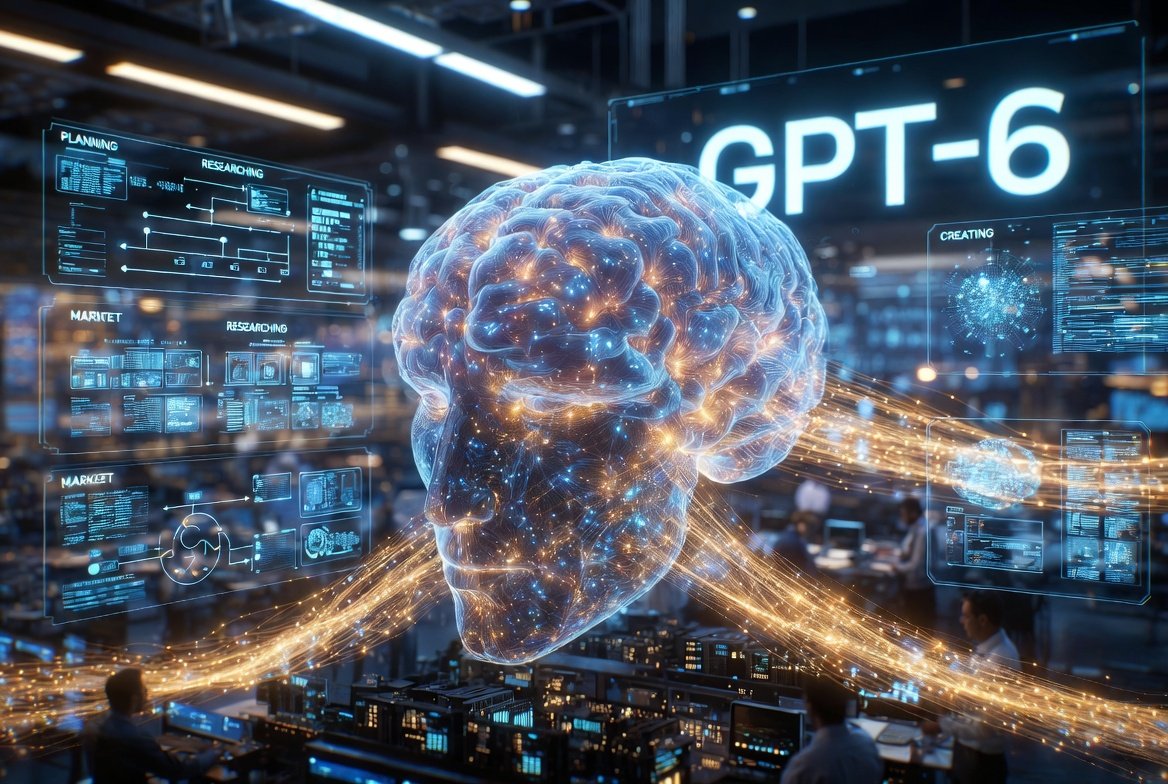
Explore GPT-6 features in 2026, including Intelligent UI, advanced reasoning, coding, data analysis, and productivity improvements in ChatGPT.
Artificial intelligence continues to change how people work, learn, create content and solve problems. In 2026, OpenAI’s GPT-6 model family represents another important development in the evolution of ChatGPT and generative AI.
With improvements to in reasoning skills, interactivity, and task completion processes, GPT-6 aims at making AI assistance more relevant and beneficial for all kinds of everyday uses and professional practices.
On October 7, 2026, OpenAI made available for ChatGPT users a new version of GPT-6 and Intelligent UI, offering an innovative approach to interaction with information via visual means.
The new trend in the field of artificial intelligence presupposes not just a text assistant, but also a tool which helps people in exploring information and performing various tasks.
In this article, we examine “GPT-6 features in 2026″, their practical applications, and what users should consider before adopting the latest AI capabilities.
What Is GPT-6?
GPT-6 falls under the new set of large language models developed by OpenAI that are meant for understanding instructions, responding to them, and offering assistance in analysis and content creation.
Just like other generations of GPT, the sixth generation too understands user instructions and responds to them on the basis of its training and information that it receives through its abilities.
But the main focus of GPT-6 is problem solving, interactive experience, and workflow.
The OpenAI’s DevDay announcements of September 2026 featured several developments linked to each other, such as GPT-6 updates, development of new abilities for developers, and autonomous AI agents.
These innovations form a bigger trend towards systems that can integrate understanding of languages with tools, applications and workflows.
For a broader explanation of this transition, read NextAnalytics’ guide to agentic AI and autonomous AI agents.
Key GPT-6 Features in 2026
1. Improved Reasoning and Problem-Solving
The primary use of AI systems is their ability to reason through complex problems.
GPT-6 is created for processes that require planning, analysis, mathematical reasoning, and solving multi-step problems.
For example, a business analyst may use GPT-6 to evaluate various options, analyze financial performance, or even work on research projects.
Students can use the system to understand complex topics, while professionals can use it to compare different alternatives.
However, reasoning capabilities should not be confused with guaranteed accuracy Even an AI model may make mistakes when formulating assumptions or creating explanations.
Users should verify important calculations, factual statements and decisions against reliable information.
2. Intelligent UI and Interactive Responses
OpenAI’s October 2026 announcement highlighted Intelligent UI as an important development in the ChatGPT experience.
Traditional AI conversations primarily rely on written questions and text-based answers.
interactive interface may assist in making some information understandable via using visuals.
For example, when trying to understand some math equation, one may use an interactive calculator, whereas for understanding business-related information, one may need charts or tables of comparison.
These interfaces may simplify the process of understanding complex answers.
In general, the idea is to make AI communication practical, not every activity should be done via chat.
3. Coding and Software Development Assistance
GPT-6 has capabilities in programming workflow processes such as code interpretation, debugging, and software development planning.
Programmers have an ability to depend on AI assistance in understanding code that is new, debugging, testing and documenting technical decisions.
AI can be used by novices to get a better understanding of programming through simpler terms.
More experienced programmers can utilize AI to carry out repetitive functions and accelerate certain phases of development.
AI-generated code must undergo testing, verification of security and human oversight before its release into production.
Organizations must refrain from viewing such code as inherently safe and secure.
4. Business Productivity and Research
GPT-6 can support professional activities such as drafting reports, organizing meeting information, summarizing documents and developing project plans.
Consider a research specialist preparing a proposal.
The AI can also help to organize project storylines, find unclear points, make a checklist, and provide improvements to document structure.
At the same time, a marketer can apply the AI to compare marketing campaigns, create content ideas, and arrange customer feedback.
The most important aspect here is the possibility to save time on preliminary activities without losing human evaluation.
It is also essential to remember about the importance of confidentiality when sending internal documents to AI services.
5. More Interactive Data Analysis
Analysis of data is another field where modern artificial intelligence assistants could be helpful.
Instead of analyzing all the spreadsheets and graphs manually, one could ask questions related to certain trends and peculiarities.
For example, a sales manager could ask questions about quarterly fluctuations in revenue or about comparison between product categories.
This way, AI can assist in making a summary as well as generating further queries for analysis.
However, the outcome is contingent upon the quality of data, analytical software, and calculations provided.
For related developments, explore 7 Data Analytics Trends Businesses Should Watch in 2026.
GPT-6 vs Earlier GPT Models
The evolution from earlier GPT generations involves more than generating longer or more detailed answers.
Recent improvements increasingly focus on reasoning, tool integration, interactive experiences and completing practical tasks.
| Capability | Earlier GPT Experiences | GPT-6 Generation |
|---|---|---|
| Conversational Assistance | Established capability | Continued development |
| Reasoning | Supported | Greater emphasis on complex tasks |
| Interactive Interfaces | Limited or product-dependent | Expanded Intelligent UI |
| Coding Assistance | Available | Continued model and workflow improvements |
| Business Applications | Primarily assistance-oriented | Increasingly integrated with workflows |
| Agentic Systems | Emerging | Broader ecosystem of agents and tools |
This comparison describes general product direction rather than a controlled benchmark. Performance differences vary by model, task and configuration.
How Businesses Can Use GPT-6
Organizations can apply GPT-6 across different departments.
Marketing: Teams can develop content outlines, summarize audience research and compare campaign ideas.
Finance: Analysts can organize financial explanations, examine uploaded information and prepare draft reporting narratives.
Human Resources: HR teams can draft training materials, organize policy documents and prepare onboarding resources.
Education: Teachers and students can use AI for explanations, study planning and instructional materials.
Research: Researchers can develop outlines, refine technical writing and organize literature-review questions.
Software Development: Developers can investigate programming problems and accelerate documentation.
These examples are potential applications rather than evidence of guaranteed productivity improvements.
What Are the Limitations of GPT-6?
Despite advances in artificial intelligence, several limitations remain important.
The responses provided by artificial intelligence may not be factually correct or up-to-date.
Complex tasks may require additional tools permissions, and human involvement are required.
Businesses have to consider issues of privacy, security, and regulations while implementing AI technology for dealing with confidential information.
Finally, access to particular features and models is dependent on subscription types, geographical location, and configuration of the product.
Users should review OpenAI’s official product announcements for current availability.
The Future of GPT-6 and Generative AI
Given the current development trends of AI technologies, it is easy to assume that in the future, such technologies will become even more embedded into the software and the business operations of organizations.
Unlike before, when an AI assistant could only answer a question, nowadays it can help a person handle his tasks, communicate with data, and work with applications.
he increasing significance of autonomous agents is contributing to the trend
NextAnalytics explores these developments in its coverage of how autonomous AI agents work.
For businesses, successful adoption will require more than choosing the newest model. Organizations must identify practical use cases, train employees, protect sensitive information and evaluate measurable results.
Conclusion
GPT-6 represents another stage in the development of generative artificial intelligence.
Its growing ecosystem of reasoning capabilities, interactive interfaces, coding assistance and productivity tools demonstrates how AI is moving beyond conventional text-based conversations.
For individuals, these developments may simplify research, learning and everyday work.
For organizations, they create opportunities to improve workflows while introducing new responsibilities involving security, accuracy and governance.
The most effective approach is to treat GPT-6 as a capable assistant that supports human expertise rather than replaces it.
Frequently Asked Questions (FAQs)
1. What is GPT-6?
GPT-6 is OpenAIs generation of language models supporting conversational assistance, reasoning, content generation and various productivity applications.
2. What are the main GPT-6 features?
Important capabilities include reasoning, coding assistance, interactive responses, document analysis and integration with supported tools and workflows.
3. Is GPT-6 better than GPT-5?
GPT-6 represents a model generation but performance differences depend on the task and model configuration. Users should consult benchmarks for specific comparisons.
4. Can GPT-6 help with data analysis?
Yes. GPT-6-powered experiences can help explain data identify trends and assist with analysis when suitable data and tools are available. Important findings should be verified.
5. Is GPT-6 available to everyone?
OpenAI announced GPT-6 availability in October 2026. However access, to models, features and usage limits depends on the users plan and product configuration.