Discover how AI agents are transforming business operations in 2026 by automating workflows, improving customer support, boosting productivity, and enabling smarter decision-making.
Artificial Intelligence (AI) has moved beyond simple automation tools and chatbots. In 2026, AI agents are becoming intelligent digital assistants capable of understanding goals, making decisions, and executing complex workflows with minimal human intervention. Businesses across industries are rapidly adopting AI agents to improve productivity, reduce operational costs, enhance customer experiences, and accelerate digital transformation.
Unlike traditional AI applications that perform isolated tasks, AI agents can integrate with enterprise software, analyze vast amounts of information, and complete end-to-end business processes. As organizations embrace automation, AI agents are emerging as one of the most transformative technologies shaping the future of work.
What Are AI Agents?
AI agents are autonomous software systems designed to perform tasks intelligently without requiring constant human guidance. They combine technologies such as Large Language Models (LLMs), machine learning, natural language processing (NLP), APIs, and workflow automation to understand objectives, analyze information, and execute actions.
Unlike standard chatbots that simply answer questions, AI agents can perform complex business functions such as managing customer support tickets, generating reports, scheduling meetings, processing invoices, and interacting with multiple business applications. Their ability to reason and make context-aware decisions makes them valuable across many industries.
How AI Agents Work?
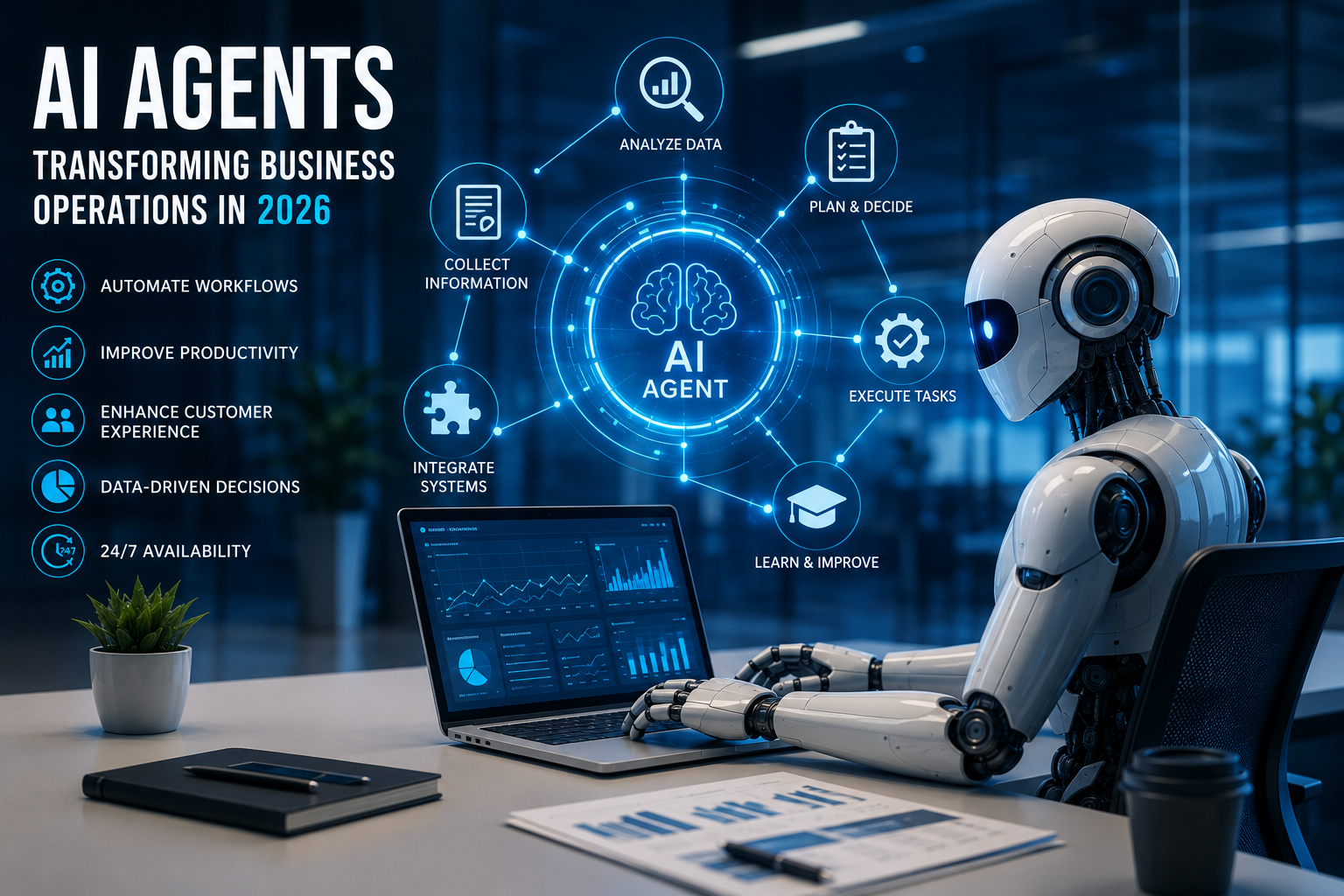
AI agents operate through a combination of intelligent technologies and enterprise integrations. They first receive a user request or business objective, interpret the intent using natural language processing, gather relevant information from connected systems, and determine the best course of action.
After analyzing available data, the AI agent executes tasks such as updating databases, sending emails, generating reports, or interacting with customers. Many AI agents continuously learn from previous interactions, enabling them to improve accuracy, efficiency, and decision-making over time.
Key Benefits of AI Agents
Increased Productivity
AI agents automate repetitive administrative tasks, allowing employees to focus on strategic initiatives, innovation, and customer relationships.
Cost Reduction
Organizations reduce operational expenses by minimizing manual work, improving efficiency, and reducing human errors.
Better Customer Support
AI-powered support agents provide instant responses, resolve routine issues, and offer 24/7 customer assistance while escalating complex cases when necessary.
Faster Decision-Making
By analyzing large datasets in real time, AI agents help business leaders make informed decisions more quickly and accurately.
24/7 Business Operations
Unlike human teams, AI agents work continuously, ensuring uninterrupted customer support and business process automation.
Industry Applications of AI Agents
Healthcare
Hospitals and healthcare providers use AI agents to schedule appointments, manage patient records, assist doctors with documentation, and improve operational efficiency.
Finance
Banks use AI agents for fraud detection, compliance monitoring, customer service, and financial reporting.
Retail & E-commerce
Retail businesses leverage AI agents for personalized recommendations, inventory management, automated customer support, and order processing.
Manufacturing
Manufacturers implement AI agents for predictive maintenance, production monitoring, quality control, and supply chain optimization.
Marketing
Marketing teams use AI agents to generate content, analyze campaigns, personalize customer engagement, and automate marketing workflows.
Human Resources
HR departments use AI agents for recruitment, resume screening, interview scheduling, onboarding, and employee support.
Challenges Businesses Must Address
Data Privacy and Security
Organizations must protect sensitive customer information by implementing strong cybersecurity measures and complying with data privacy regulations.
Human Oversight
Critical business decisions should continue to involve human review to ensure accountability and ethical decision-making.
Integration Complexity
Successfully integrating AI agents with CRM, ERP, and enterprise software requires careful planning and technical expertise.
Ethical AI
Businesses must ensure AI systems operate fairly, transparently, and without bias to maintain customer trust.
Future Trends in AI Agents
The next generation of AI agents will feature greater autonomy, improved collaboration through multi-agent systems, deeper integration with enterprise software, and stronger security capabilities. Organizations will increasingly deploy specialized AI agents that work together to complete complex business workflows.
Future AI agents are also expected to integrate with robotics, IoT devices, and cloud platforms, creating intelligent ecosystems that improve productivity across industries.
Best Practices for Implementing AI Agents
Businesses should begin with small automation projects before expanding AI initiatives across departments. They should establish clear governance policies, protect sensitive data, train employees to collaborate with AI tools, and continuously monitor AI performance. Maintaining human oversight remains essential for critical business operations.
Conclusion
AI agents are redefining business operations by automating workflows, improving customer experiences, reducing costs, and enabling faster decision-making. As organizations continue their digital transformation journey, AI agents will become indispensable tools for increasing efficiency and driving innovation.
Although challenges such as data security, ethical AI, and system integration remain important, businesses that implement AI responsibly will gain a significant competitive advantage. The future of work is increasingly collaborative, with humans and AI agents working together to create smarter, faster, and more efficient organizations.