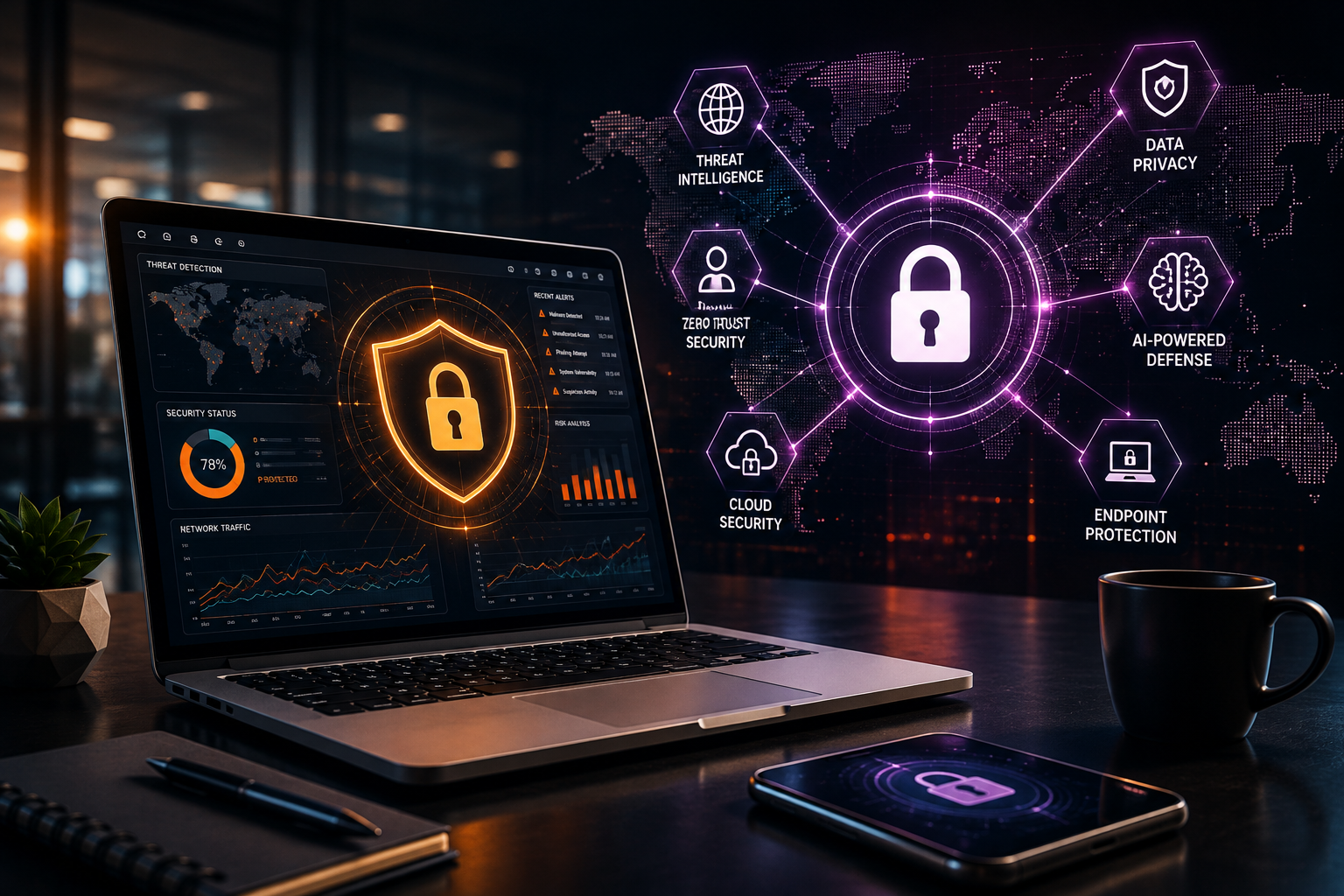
Explore cybersecurity trends 2026, including AI-powered attacks, ransomware, identity security, cloud security, AI agents, shadow AI, and post-quantum cryptography.
Cybersecurity trends, in the year 2026 are being influenced by intelligence. These trends are also being shaped by cloud platforms. Connected applications are part of the changes happening. Identity threats are becoming more common. Cyberattacks are growing more advanced and harder to stop.
At the time cyber threats are becoming faster and more sophisticated. Artificial intelligence can help attackers create phishing campaigns, automate parts of cyberattacks and identify potential vulnerabilities. Security teams are also using intelligence to analyze threats investigate incidents and respond more efficiently.
This creates a cybersecurity area where technology gives power to both attackers and defenders. I want to share the important cybersecurity trends for 2026 that businesses must understand and prepare for.
1. AI Is Changing Both Cyberattacks and Cyber Defense
Artificial intelligence has rapidly emerged as a driver of cybersecurity. Attackers can use AI to help create phishing messages spoof the identities of trusted users perform reconnaissance and automate certain phases of the attack process.
For businesses this means that existing red flags will become less useful. In the past bad grammar and typos were characteristics that made phishing messages easy to recognize. However artificial intelligence can help generate looking correspondence.
The security team can use intelligence to process many alerts, detect anomalies summarize events and support investigation processes. Rather than having analysts review every alert artificial intelligence can help them focus on the important activity.
This is a trend of using artificial intelligence for data analytics, where companies use intelligent technologies to find patterns in ever-growing volumes of data.
2. Identity Security Is Becoming More Important
Cybersecurity used to focus on securing networks and devices.. Modern business operations are different. Employees access applications remotely many cloud platforms are used contractors have access to systems and applications talk to each other via APIs. That is why digital identity is a valuable asset to protect. Businesses must look beyond passwords. Multi-factor authentication, privilege access, privileged account management, access reviews and detection of suspicious login activity become key security controls. The idea is simple: even if a person is authenticated they should have access to the information and systems needed for their role.
3. AI Agents Introduce New Security Risks
AI agents are becoming increasingly important in business. They can do more than just produce texts. Agents can communicate with apps gather data, analyze data call APIs and act on behalf of a user.
This creates a cybersecurity threat to businesses. Consider an AI agent that accesses customer data updates the CRM database sends emails and collects statements. If the agent is hacked or controlled its privileges can be used against the business.”
Businesses must treat AI agents as entities with well-managed access rights. The agent must have defined access, monitoring, authentication and limited ability to perform actions.
This is directly related to the use of autonomous AI. In an article it was explained that AI agents are revolutionizing business practices by automating processes and enabling organizations to move from information to action.
4. Ransomware Remains a Serious Business Risk
Ransomware attacks have not disappeared in 2026. Attackers have evolved their techniques for entering organizations.
This is why ransomware protection cannot rely on a security product. Multiple levels of security are necessary such as identity security, security awareness endpoint security, network segregation, backups and incident response.
Backups are crucial but having them is not enough. Organizations must ensure that critical systems and data can be restored from backups within a time. Resilience is becoming key in cybersecurity.
5. Shadow AI Creates a New Data-Security Challenge
Employees use AI for writing, research, coding, analytics and productivity. While this can bring business value it can also create security risks if the AI platforms used by employees are not authorized by their organization.
The problem is not the AI platform itself; it is the information that employees input into it. Employees may accidentally. Paste sensitive information about the company, its customers, proprietary code, internal documents or research into an external AI system.
Businesses need policies that specify which AI platforms employees may use and what types of information cannot be entered into any external system. Organizations should also provide authorized AI systems wherever possible. AI governance and cybersecurity are becoming increasingly important.
6. Cloud Security Requires Continuous Visibility
Cloud computing still powers applications, databases, analytics engines and recently AI platforms. However modern cloud environments are complex.
They may include storage solutions, APIs, containers, serverless apps, databases, identities, AI services and third-party integrations. A security issue may arise without an attacker breaching security layers. A configured account, leaked storage asset or configuration problem can cause major problems.
Cloud security in 2026 will focus on monitoring. Firms must know who accesses assets, which systems hold sensitive data how APIs are secured and whether the configuration follows the security policy.
7. Third-Party Cyber Risk Continues to Grow
Modern businesses rely heavily on external technology providers. Cloud platforms, software vendors, payment processors, contractors, APIs and SaaS applications may all interact with company information.
This means an organizations security can be affected by companies outside its control.
Organizations should evaluate vendors not by features and cost but also by cybersecurity risk. Businesses must understand what information a vendor can access what could happen if the vendor is compromised whether its access can be removed quickly and how dependent business operations are on the service.
8. Post-Quantum Security Moves Closer to Business Planning
Quantum computing is not breaking business encryption at scale in 2026 but organizations are starting to prepare for a future where current cryptographic systems may not provide adequate protection.
For businesses this does not mean replacing every encryption system immediately. The first step is understanding where cryptography is currently used.
Organizations should identify systems know which algorithms protect them decide which information must stay confidential for many years and check whether vendors plan to support post-quantum standards. Preparing early can make later migration much easier.
Cybersecurity Trends 2026: What Businesses Should Prioritize
The cybersecurity environment may be changing, but organizations should not simply buy every security product
Businesses should strengthen identity controls, patch critical vulnerabilities quickly, establish clear policies for AI use, secure cloud environments, maintain reliable backups, assess third-party risk, train employees, and regularly test incident-response plans.
AI should also be incorporated carefully into security operations. Automation can help security teams work faster, but organizations still need human oversight for decisions that could affect critical business systems. The objective is to create security that supports innovation rather than preventing it.
The Future Outlook
Cybersecurity in 2026 is about much more than protecting computers. Businesses now need to protect employees, digital identities, cloud infrastructure, APIs, sensitive information, AI systems, autonomous agents, and increasingly complex technology supply chains.
Artificial intelligence captures this challenge particularly well. The same technology that can help attackers create more sophisticated threats can also help security teams detect and investigate those threats faster.
Businesses that succeed will not necessarily be those with the largest number of cybersecurity tools. They will be organizations that understand their risks, control access to critical information, prepare for incidents, establish responsible AI practices, and build security into their technology decisions from the beginning.
As AI and automation continue becoming part of everyday business operations, cybersecurity will increasingly become a business strategy and resilience issue – not simply an IT responsibility.



7 comments on “Cybersecurity Trends 2026: 8 Key Risks Businesses Need to Know”