Discover how conversational analytics in 2026 helps businesses analyze data without SQL using AI, natural-language queries, BigQuery, and Power BI.
Earlier, for certain complex queries related to business, one would need to have at least some level of knowledge about spreadsheets, SQL, or data analysis from data analysts.
However, it will be the conversational analytics that will alter this situation by 2026.
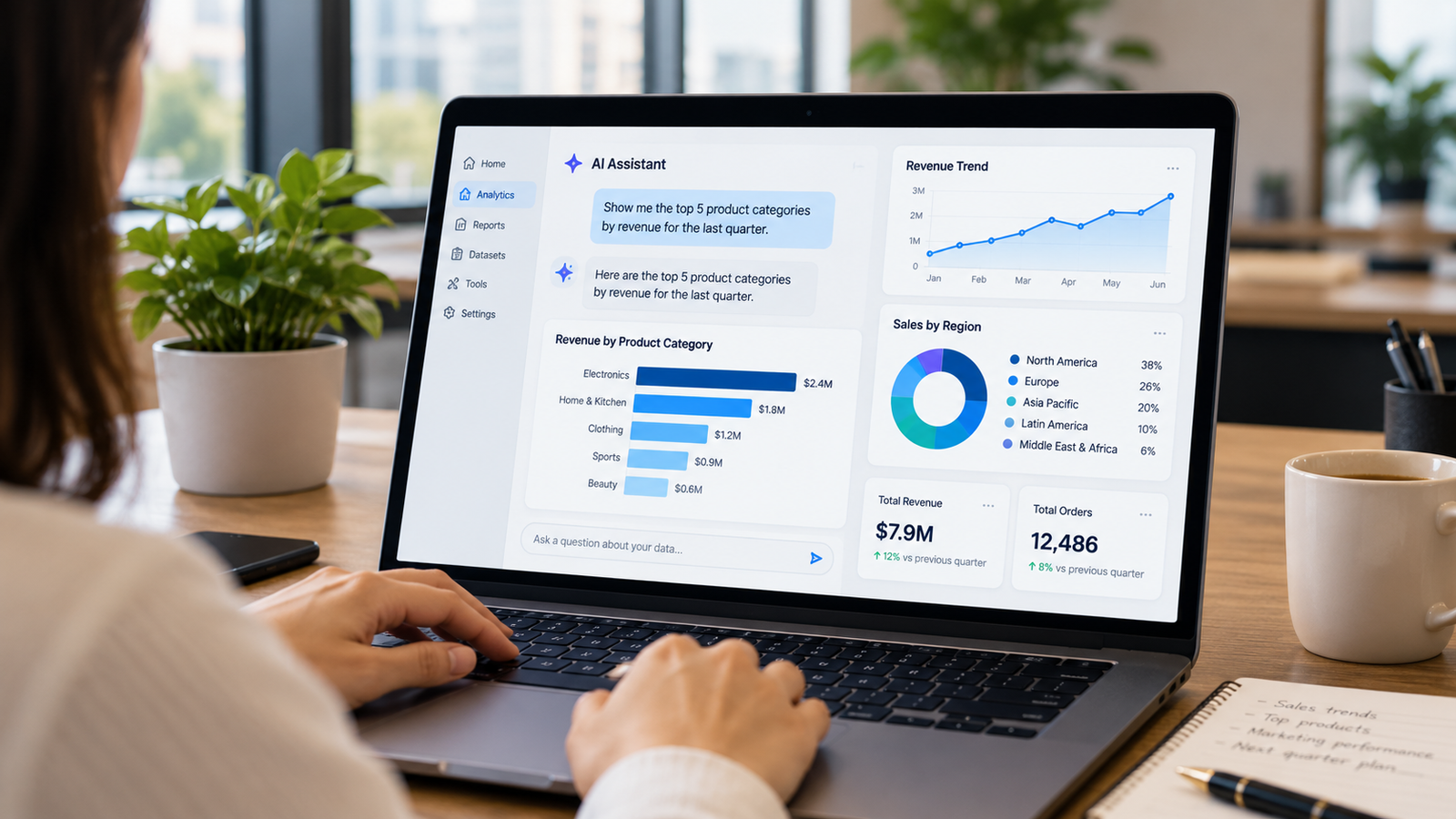
In place of writing a query in a database, the questions can now be asked in the form of natural language.
For instance, the question posed by a retail manager may be, “What are the product categories that have witnessed the highest decline in revenue generation in the last quarter?”
The conversational analytics will be able to interpret the above question and provide an answer to it.
The development of the conversational analytics technology for Google Cloud BigQuery is one such example.
On June 30, 2026, Google announced the general availability of Conversational Analytics in BigQuery.
This trend reflects the increasing use of AI for business intelligence and data analytics.
What Is Conversational Analytics?
Conversation analysis is the name given to a type of data analysis which takes place during the course of a conversation.
In contrast to the approach wherein all the work takes place via database inquiries or control dashboards, questions are asked by the user in conversation.
The program then analyzes the question, retrieves the pertinent information and responds.
This depends on the platform and can include text, tables, graphs, or even questions for further exploration.
For example, a business owner could ask:
“How did sales performance change between January and June?”
The system will be able to access the necessary records and perform calculations on changes and outcomes.
Conversational analytics is not making structured data and analysis redundant.
On the contrary, it provides a simpler means of interacting with existing data systems.
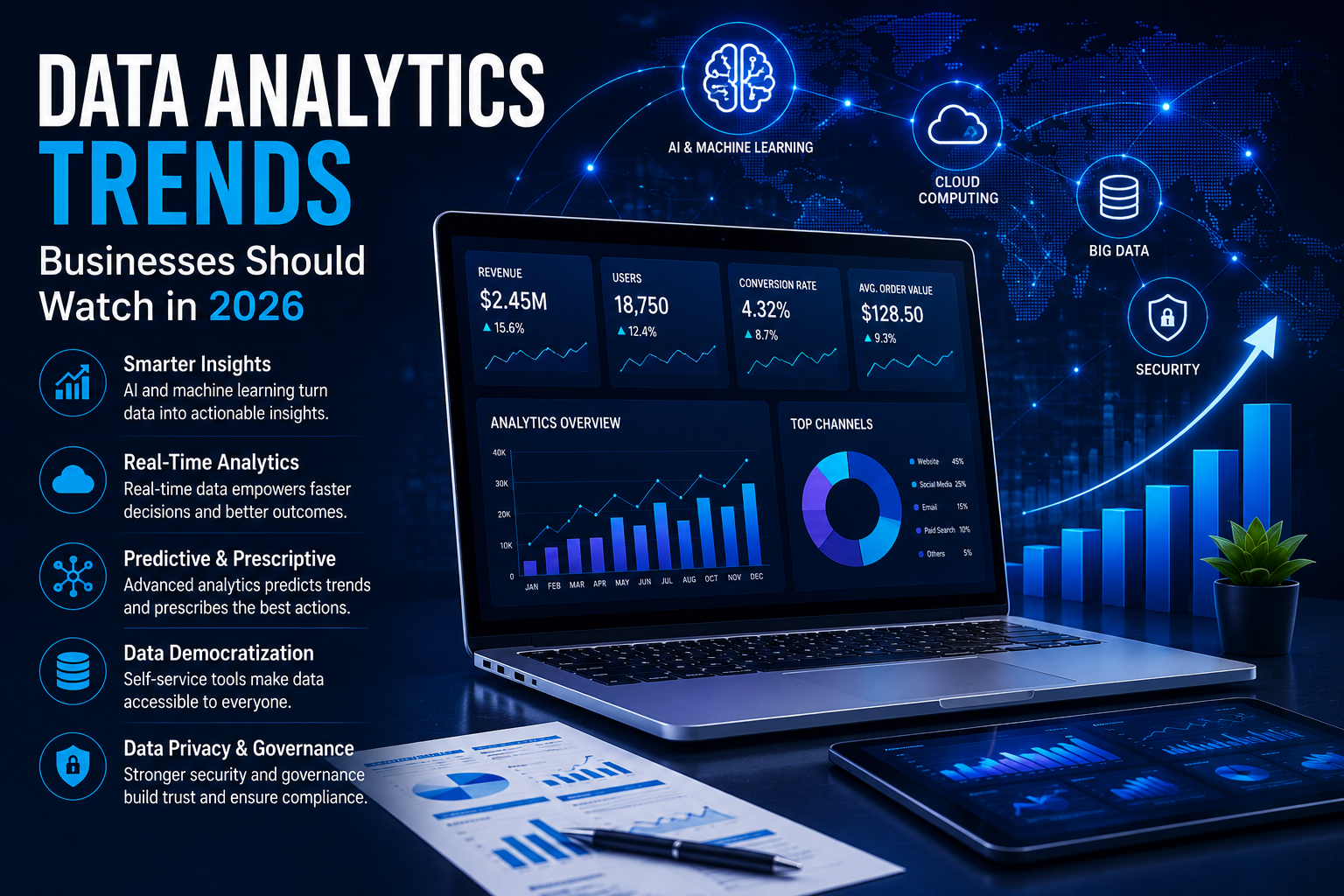
For additional context, explore 7 Data Analytics Trends Businesses Should Watch in 2026.
How Does Conversational Analytics Work?
There are multiple technologies used in conversational analytics.
This may include natural language processing, large language models, databases, and business intelligence applications.
Conversation analytics is typically initiated by posing a question by the user.
AI understands the concept and locates the relevant sources of data for this question.
AI can also construct the query, collect the data, and calculate the answers.
Eventually, the answer or its visualization is displayed to the user.
For instance, the user can enquire as to which area had the maximum sales revenue.
The analytical engine may then find the sales revenue field, group results according to regions, and sum up the sales.
The answer may contain a ranked table and a graph.
While the interface looks conversational, certain technical actions still take place in the background.
Key Features of Conversational Analytics
1. Natural-Language Data Queries
One of the most important aspects is that queries can be raised without writing any SQL codes.
All that needs to be done is to specify what kind of information is needed in simple language.
For example, a marketing manager might ask:
“Which campaign generated the highest conversion rate last month?”
With the proper configuration, such a system will be able to recognize the relevant metrics and arrive at the solution.
The advantage of such a system is that it will help minimize reliance on technicians for answering common questions.
Nevertheless, sometimes vague queries may need some further explanation.
2. Automated Data Visualization
Conversational analytics platforms can generate charts and tables based on user questions.
For example, an individual looking into revenues per month could get a line chart.
One analyzing product performance could obtain a bar chart.
Automatically generated visualizations may contribute to understanding the results better.
Still, the user should make sure that the selected visualization correctly represents the data used.
This is due to the fact that inappropriate visualizations may cause incorrect conclusions despite correct computations.
3. Context-Aware Analysis
With the aid of modern analytics systems, questions can be interpreted using business definitions and metadata.
This is significant since different organizations have their own interpretation of metrics.
For example, whereas one company defines its revenue as its gross sales, another company may define its revenue as net sales minus sales returns.
The analytics tool with context awareness is programmable to align with the definition of the organization.
Google BigQuery makes it possible for you to implement your data agents using metadata, instructions, and validated queries.
4. Predictive Analytics
Some conversational analytics platforms support predictive analysis.
Users are not only concerned with what has taken place but what might happen subsequently.
For instance, a sales forecast for the coming quarter can be asked for by a retail organization.
This can be done using data and functions of forecasting within the system.
Predictions, however, are never guaranteed.
Forecasting quality depends on historical data, assumptions, model selection and changing business conditions.
5. Multi-Step Analysis
Conversational analytics can support follow-up questions.
For example, a user might first ask which region experienced the largest sales decline.
The next question could be:
“Which products contributed most to that decline?”
A good system would leverage on the conversational context to proceed with the analysis.
The process is far more exploratory as compared to the construction of different database queries each time.
Popular Conversational Analytics Platforms
Several enterprise platforms offer natural-language analytics capabilities.
Google BigQuery
Google Cloud provides conversational analytics capabilities within BigQuery.
Users will be able to engage with the sources of data that are supported via AI-based agents.
Google can leverage business metadata and validated queries to give better responses.
Analytical explanations and visualizations are also possible with this platform.
Learn more through Google Cloud’s conversational analytics documentation.
Microsoft Power BI
Analytical features based on conversational analytics and AI have been offered by Microsoft Power BI, which include supported features, and also Copilot experience.
Users will be able to interact with data and create reports using the feature of natural language.
But availability of certain features will depend on licenses and configuration updates.
Tableau
These capabilities are available in the natural language and AI-powered analytics offered by Tableau in their business intelligence platform.
Such tools can help in data exploration and the presentation of findings from data analysis.
Connection to the data, governance requirements, and costs need to be taken into consideration for each solution.
Business Applications of Conversational Analytics
Sales and Marketing
Sales teams can analyze revenue performance, customer segments and campaign results.
Marketing professionals can investigate engagement trends and compare campaign outcomes.
Finance
Finance departments can utilize conversational analytics to assist in analyzing expenses, comparing budgets, and reporting.
Nonetheless, any financial computation must be independently verified.
Human Resources
The HR department can conduct analysis on workforce trends, training attendance, and recruitment trends by using authorized data.
Confidential data about employees requires adequate privacy protection.
Retail and E-Commerce
Product demand, inventory management, and customer buying habits can be analyzed by the retailers.
The analysis could provide valuable information for the retail business operation.
Healthcare
Healthcare organizations can implement governed analytics to study organizational efficiency and the use of resources.
In case there is any involvement of patient data, due diligence should be paid to privacy and security issues.
Benefits of Conversational Analytics
Accessibility is another advantage.
Non-technical employees can potentially respond to regular queries without much help.
This reduces the time that is wasted on such analysis.
Speed is another key advantage.
Using natural language interfaces could potentially decrease the amount of time it takes to find relevant data and generate preliminary insights.
Analytics of conversation could also contribute to fostering greater data literacy.
However, success requires correct information and business definitions.
These technologies work best where there are already good data processes in place.
Challenges and Limitations
Conversational analytics is not free from errors.
AI systems may misunderstand questions or generate incorrect queries.
They can also make wrong interpretations when there are vague definitions in the business.
The quality of data is another issue that comes into play.
The problems of missing data, duplication of data and incorrect formats pose an issue.
There is also the issue of security as these systems have access to organizational data.
Firms need to set up permissions, track access to data, and verify relevant outputs.
Google itself notes that outputs generated by AI might seem valid but be false.
It is for these reasons that conversational analytics must support business analysis judgment rather than replace it.
Conversational Analytics vs Traditional Business Intelligence
| Feature | Traditional BI | Conversational Analytics |
|---|---|---|
| User Interaction | Dashboards and queries | Natural-language questions |
| Technical Knowledge | Varies by task | Lower barrier for routine questions |
| Visualizations | Manually designed or configured | May be generated automatically |
| Follow-Up Analysis | Filters and additional queries | Conversational exploration |
| Data Governance | Required | Equally important |
| Human Validation | Important | Important |
Conversational analytics is best understood as an additional way to interact with business intelligence systems.
It does not replace the need for data models, governance or analytical expertise.
How Businesses Can Get Started
Organizations should begin by identifying a specific analytical problem.
Another example may be reducing the amount of time spent by employees on making monthly sales reports.
Next comes evaluation of the quality of data and selecting valid data sources.
Businesses should select a platform that fulfills their technical and security needs.
A limited pilot program can be helpful in establishing the accuracy, usability and time-saving aspects of the process.
Training of employees regarding how to write appropriate questions and confirm the outcomes is essential.
With successful piloting, further expansion of the program to other divisions is possible.
The Future of Conversational Analytics
The analytics of conversations will most likely become more integrated with AI agents and automated processes within businesses.
Besides answering questions, the future technologies will help analyze for any anomalies and determine the causes as well as actions needed to be taken.
For example, an analytics agent will detect a decline in sales and generate a report about the reasons behind it.
However, human endorsement must remain intact for major decisions.
The most critical systems would be those that have good data, good explanation, and good governance.
Conclusion
Conversational analytics is changing how businesses interact with information.
By allowing users to ask questions in natural language, it can make analytical tools more accessible and reduce the technical barriers associated with routine reporting.
Developments in platforms such as Google BigQuery demonstrate how AI-powered analytics is becoming more integrated into enterprise data systems.
Nevertheless, businesses must address data quality, security and accuracy before relying on automated insights.
Conversational analytics is not about eliminating analysts or SQL. It is about making reliable data more accessible to the people who need it.
Frequently Asked Questions (FAQs)
1. What is conversational analytics?
Conversational analytics allows users to analyze data by asking questions in natural language instead of manually writing database queries.
2. Can conversational analytics work without SQL knowledge?
Yes. Many platforms allow users to ask questions without writing SQL, although the system may generate SQL or perform other technical operations internally.
3. What are examples of conversational analytics tools?
Examples include conversational analytics capabilities in Google BigQuery, Microsoft Power BI and Tableau.
4. Is conversational analytics accurate?
Accuracy depends on data quality, business definitions, system configuration and the analytical task. Important results should be validated.
5. Will conversational analytics replace data analysts?
It may automate some routine requests, but analysts remain important for data modeling, governance, complex investigations and interpreting business results.