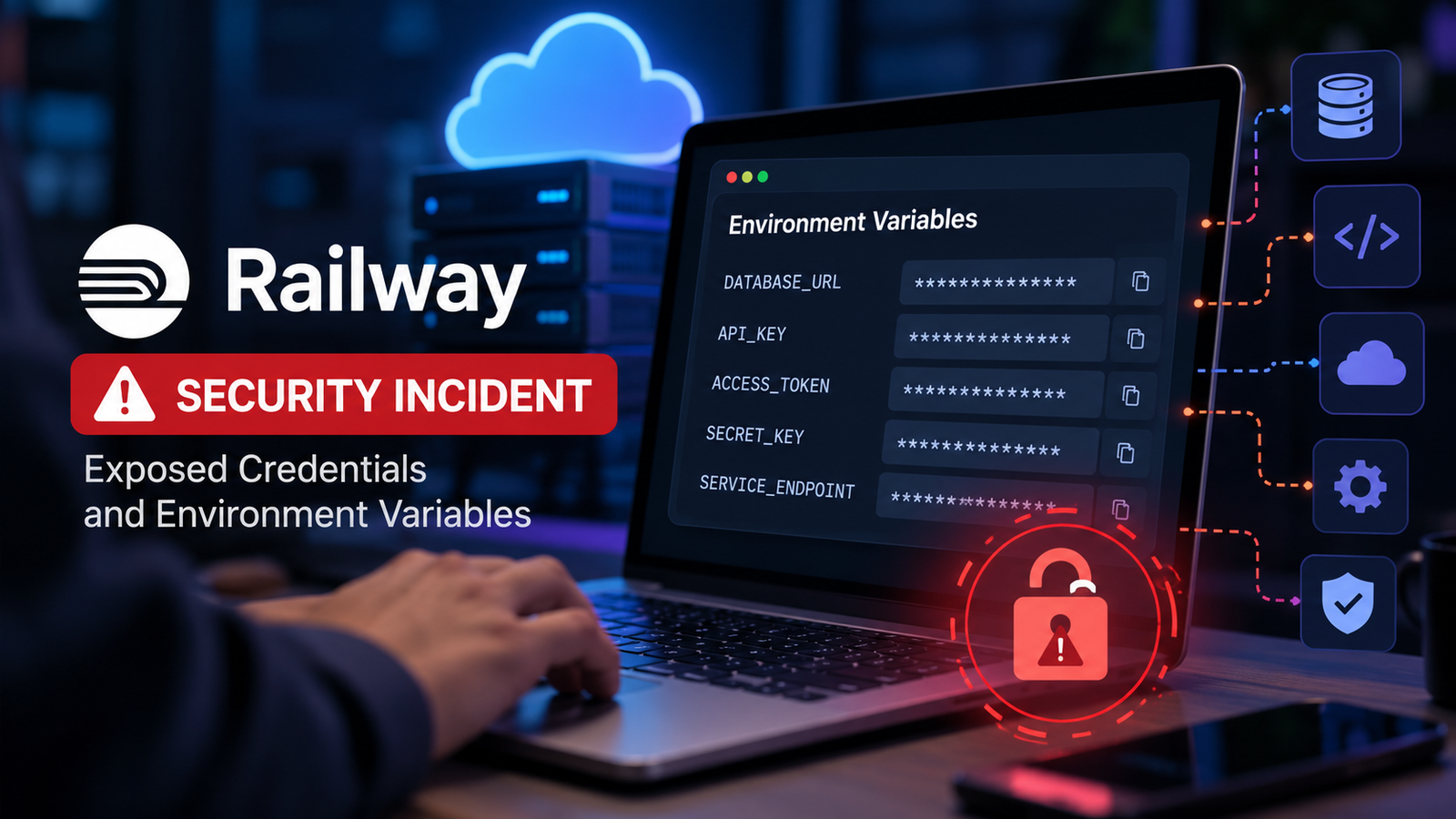
Railway security incident: Learn about exposed credentials, environment variables, credential rotation, and essential cloud security practices.
Railway, a cloud platform used by developers to deploy and operate applications, disclosed a security incident on October 21, 2026. According to the company, an unauthorized third party may have accessed customer environment variables, including potentially sensitive credentials used by applications.
It becomes especially crucial since the contemporary cloud applications are heavily reliant on secrets such as database passwords, API keys, and access tokens. In case these credentials are disclosed, the attacker might gain access to the connected systems even if he or she does not breach the application.
Railway advised customers to rotate their credentials and check logs in connection with ongoing investigation. The current case study offers a great chance to learn more about cloud secrets.
What Is Railway?
Railway is a cloud-based development platform that assists developers in deploying applications without having to manage each component of the underlying infrastructure.
For instance, when developing an e-commerce store, the developer would be required to run a web application, have a database, and configure the mail and payment services among other services.
A platform like Railway may help in some aspects of the deployment process through features that facilitate hosting applications and configuring them.
But this does not mean that one does not have to take security into account anymore; applications will always need well-managed access.
What Happened During the Security Incident?
Railway reported detecting unusual activity involving systems that store customer environment variables.
Its initial investigation indicated that an unauthorized party may have accessed encrypted environment variables and, in some cases, obtained their decrypted contents.
The company stated that the impact might be limited to a subset of customers, but it nevertheless recommended precautionary action for all users.
As of the point of disclosure, Railway had suspended deployments pending the outcome of the investigation. Users were asked to refer to the official company statuses for information regarding the availability of services.
The investigation was still underway, therefore the true scope of the situation could not be considered final.
What Are Environment Variables?
Environment variables are configuration values that applications can read while running.
Developers commonly use them to store settings such as database connection details, API credentials, service endpoints, and application secrets.
For instance, the site could utilize an environment variable to indicate which database it needs to connect to. Another variable could hold an API key required for making requests to the external system.
The above method allows for isolation of sensitive information from regular application code.
But then again, just placing the secret keys within the environment variable does not ensure their security by default. It is rather dependent upon many other things.
Why Are Exposed Credentials Dangerous?
A leaked API key or database password can potentially allow an unauthorized party to interact with a connected service.
It will all depend on the extent of what the credential will allow. If the key gives only read privileges, then there will be a different kind of risk compared to a key that allows modification of data and managing the infrastructure.
For instance, if the key can access customer databases, then the hacker may try to steal the information. If the key allows modification of cloud assets, then the hacker may be able to do just that.
This is why security teams emphasize least-privilege access, which means giving credentials only the permissions necessary for their intended tasks.
What Did Railway Recommend?
Railway advised customers to rotate environment variables, including API keys and private registry credentials, as a precaution.
Credential rotation involves using a new credential to replace the existing one and revoking the previous credential.
It should be done with the utmost caution since changing the password of the database without updating the applications that depend on it would cause a disruption in their functioning.
The developer should identify the services that use the credentials, create the new credentials, update the application configuration, and invalidate the old credentials.
It was also suggested by the organization that the logs of the services be checked for any abnormality.
How Should Developers Respond?
The first thing to be done is identifying which credentials have been saved in the platform. It might include database passwords, cloud access keys, registry credentials, or third-party tokens.
The next step will be cycling those credentials at the relevant service provider. Also, the developers need to check for any unanticipated authentication or unexpected request.
Permissions for application credentials must be reduced to an absolute minimum wherever possible, and reuse of the same secret must be avoided across different environments.
For broader guidance, our article on cybersecurity trends in 2026 discusses identity protection, cloud security, and the importance of incident-response preparation.
What Is the Difference Between Encryption and Access Control?
Encryption helps protect information from being read without the necessary cryptographic keys.
Access control determines which users, applications, or services are permitted to retrieve information.
Both protections are important, but they address different problems.
In cases where the perpetrator gets into a system that is capable of decrypting the data, just encryption alone may be insufficient to stop the perpetrator from acquiring any meaningful values.
This difference is able to explain why cloud computing security involves layers of security.
What Can Small Development Teams Learn?
Small teams often prioritize rapid deployment because they have limited engineering resources. However, security practices become more important as an application gains users and connects to additional services.
The following steps help mitigate risks: maintaining a list of credentials, using separate keys for the development and production environment, allowing for multi-factor authentication, and auditing permissions periodically.
It would also be useful to plan a replacement of credentials in case of emergencies. An enterprise that had conducted credential rotation before could have handled an incident faster.
These steps are important even for the teams that have never encountered any security problems.
Conclusion
The Railway incident demonstrates how sensitive configuration information can become a significant security concern when cloud infrastructure is compromised.
For developers, the central lesson is that protecting an application requires more than securing its source code. Database passwords, API keys, deployment permissions, and other credentials must also be managed carefully.
Organizations should follow Railway’s official updates, complete the recommended security actions, and use the incident as an opportunity to improve their credential-management procedures.
Frequently Asked Questions
1. What happened to Railway?
Railway disclosed suspicious activity involving systems that store customer environment variables, with possible exposure of some decrypted secrets.
2. Were all customers affected?
The company initially indicated that the impact might be limited to a subset of users. Its investigation was continuing.
3. What is an API key?
An API key is a credential used by software to authenticate or identify requests to a service.
4. What does rotating a credential mean?
It means replacing the existing credential with a new one and invalidating the old value.
5. Should Railway users take action?
Railway recommended precautionary credential rotation and log reviews for its customers.