
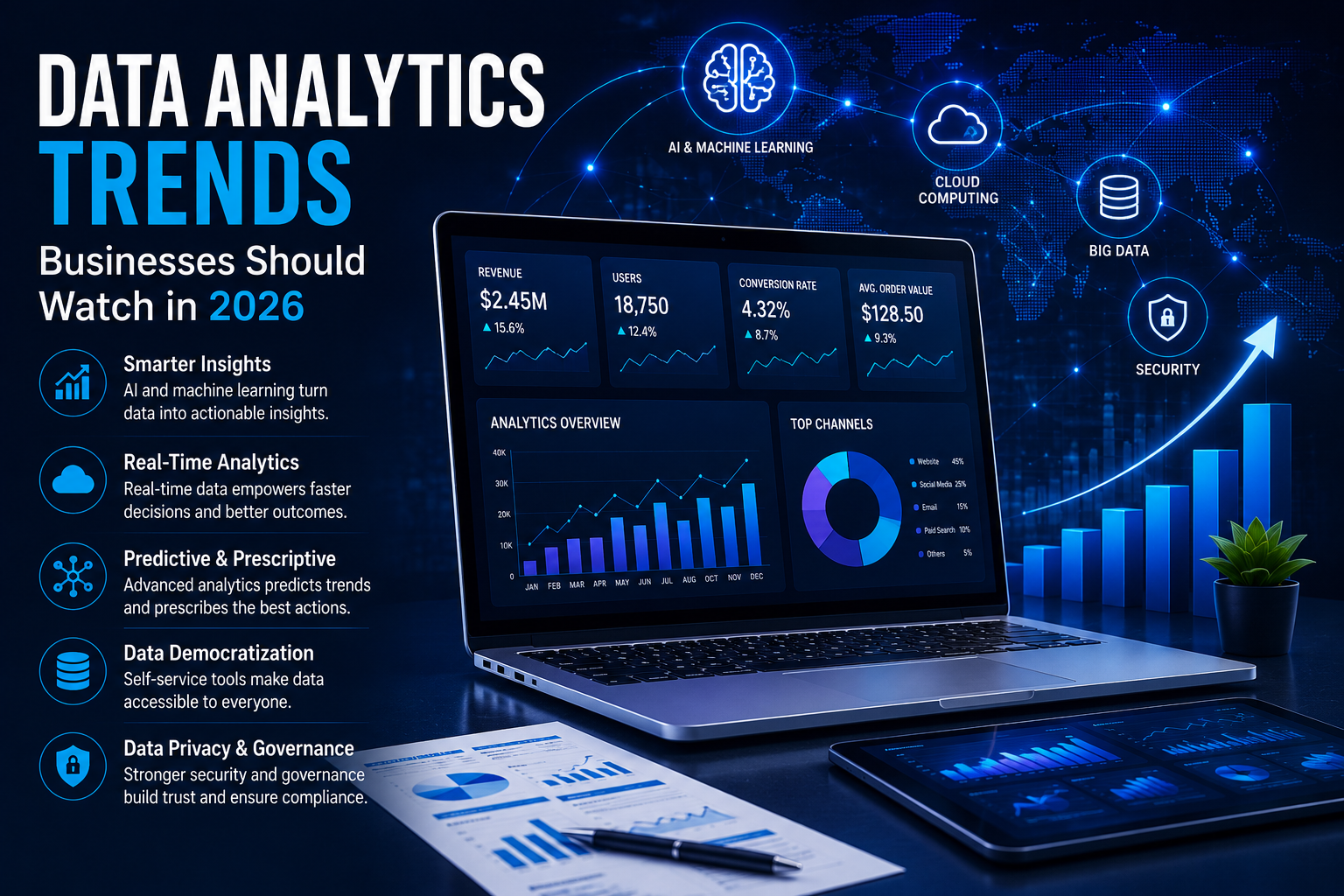
Data has been an integral part of business decision-making for a long time now, but how companies use this data is changing quickly. The old dashboards and monthly reports do not work for companies that have to react to customers, competitors, cybersecurity threats, and market changes in real time.
AI is driving this change. Analytics platforms are becoming easier to use, more automated, and better at explaining the reasons behind business data rather than just showing numbers. This means that for companies, data analytics is not limited to reporting anymore but goes deeper into decision-making.
1. AI-Powered Analytics Takes Center Stage
The use of artificial intelligence and machine learning in business intelligence is one of the most important trends in analytics.
Previously, employees would access dashboards, apply filters, compare reports, and analyze the information themselves. In this case, AI-assisted analytics may be used to help with some of the tasks, such as finding patterns in data, analyzing the information, and assisting users with analysis.
For example, instead of going through various reports manually, a sales manager can ask what reasons there are for a decrease in income in some region. With the help of AI-based software for analytics, it would be possible to analyze all available data and help identify possible contributing factors.
This does not mean that there is no need for human analysts. Human expertise is necessary, particularly where there is a lack of data or where business decisions have context that the model cannot understand. Instead, AI makes it possible to reduce the mundane aspects of analyzing data and allow analysts to focus on its real significance.
2. Real-Time Analytics Becomes Essential
Businesses have traditionally relied heavily on historical reports. Those reports are still valuable, but some decisions cannot wait until tomorrow or the end of the month.
Real-time analytics allows businesses to analyze data as it happens. Financial institutions may use real-time analytics to spot any suspicious financial activity. Retail organizations can analyze the stock and activity of customers. Manufacturing organizations can analyze their equipment performance, while cybersecurity teams can look for unusual network behavior.
The importance is obvious: the faster an organization spots any changes, the faster it can react. With more and more decisions automated by organizations, having access to current data will become critical.
3. Conversational Analytics Changes How We Use Data
Another one of the most prominent transformations in analytics regards the way that users interact with the data. Previously, in order to solve business questions, a lot of SQL skills, spreadsheet knowledge, or complicated dashboard filters.
Conversational analytics through generative AI changes this process. A businessperson can ask a question such as “Which product category saw the greatest sales decrease this quarter?” Instead of creating the report, the AI system can help the user by interpreting the question and providing an answer or visualization using the organization’s data.
This will make analytics available for a much larger number of employees, not only for analysts and technical teams. However, availability does not automatically equate to the quality of the answers provided. The data has to be good and well-governed.
4. AI-Ready Data Becomes a Business Priority
Organizations are investing heavily in artificial intelligence technology, but even the most advanced AI program cannot overcome poor-quality data from businesses.
Duplicates, inaccurate data, missing data, inconsistent data definition, and disconnected systems can all influence the quality of analysis performed. Therefore, more and more businesses focus on creating data ready for AI.
Organizations need to determine where their data is stored, whether it is correct, how different systems are connected, and who is accountable for its upkeep. Data preparation will be just as crucial for many companies as the choice of AI technology that will be used.
5. Data Governance Takes on Greater Importance
Providing AI systems with more access to information from business processes raises certain obligations. There should be a set of controls about who can access information, where it came from, what it can be used for, and how sensitive information is protected.
The importance of this aspect is especially significant when AI evolves from just providing answers to actively getting involved in business processes. Thus, governance is not a matter of mere compliance anymore; it becomes an integral part of analytics and AI.
In such cases, the firm needs to consider privacy, security, access control, data quality, data lineage, and human supervision.
6. AI Automates More of Data Engineering
Significant effort happens behind the scenes before information gets its way to the dashboard. Data engineers source data from multiple systems, clean, transform, validate it, and build pipelines to feed it to analytic tools.
Tools that leverage AI technology are starting to perform some of these tasks automatically. They can help, for example, identify problems with data quality, create documentation, suggest transformations, monitor pipelines, and troubleshoot problems.
This trend doesn’t mean that data engineers become redundant. On the contrary, it may allow them to focus on more sophisticated tasks like architecture, reliability, governance, and data problem-solving.
This shift also reflects a broader change in enterprise technology, where AI agents are transforming business operations by automating multi-step workflows and helping teams move from information to action.
7. Analytics Moves From Prediction to Action
Traditionally, analytics was concerned about the question of what had happened. With predictive analytics came the ability to ask the question of what is going to happen. Nowadays, firms are looking at analytics to solve the question of what needs to be done in response.
Take the example of a retailer that gets predictions from its analytics tools regarding stock-outs of a product. It is important information to have, but even more valuable would be a system that can determine how much stock to keep, what stores need it, and prepare an action for human approval.
That’s where analytics meets artificial intelligence and automation. This is not about making yet another dashboard. This is about bridging the gap from information to action.
What These Trends Mean for Businesses
- Improve data quality and establish consistent business definitions.
- Strengthen security, governance, and access controls.
- Use real-time analytics where speed creates genuine business value.
- Prepare data infrastructure for AI and automation.
- Automate repetitive data work while retaining appropriate human oversight.
- Connect analytics initiatives to measurable business outcomes.
The Road Ahead:
Data analytics in 2026 is becoming faster, more conversational, more automated, and more closely connected with artificial intelligence. AI-powered analytics can help people understand information faster. Real-time systems can help businesses respond sooner. Conversational analytics can make data accessible to more employees, while automation can reduce repetitive work.
But adopting the newest technology is not enough. The organizations that gain the most value from analytics will be those that combine reliable data, appropriate technology, strong governance, and human judgment. Ultimately, the future of analytics is not about creating more dashboards. It is about helping people make better decisions from the information they already have.